
Reforming Electricity Rates to Support Electrification and Low-Income Ontarians
Electrification is critical for reducing the emissions driving climate change. It can also improve indoor air quality, reduce energy costs over time and give Ontarians a greater stake in the energy transition through technologies such as solar panels, batteries and other local energy solutions.
But electrification will not happen at the scale we need without the right price signals. Ontario needs an electricity system that keeps energy affordable, encourages efficiency and electrification, and ensures that low-income households have the support they need to participate in the transition.
Affordability matters. Electricity prices have long been a sensitive issue in Ontario, and governments have introduced significant subsidies to keep electricity bills down. While these measures have helped consumers, the way Ontario currently subsidizes electricity may not be the most effective or equitable approach over the long term.
Pollution Probe is examining how Ontario can reform electricity rates and subsidies to better support both affordability and the province’s climate and electrification objectives.
Rethinking electricity subsidies
Ontario has long provided targeted electricity assistance to low-income and northern consumers and to Indigenous people living on reserves. In 2019, the province also introduced two broad programs that provide support to electricity consumers regardless of income: the Comprehensive Electricity Plan (CEP) and the Ontario Electricity Rebate (OER).
These programs represent a significant public investment. In 2025–26, the OER is expected to cost approximately $2.6 billion, while the CEP represents approximately $3.2 billion in annual costs—a combined total of about $5.8 billion—roughly the same amount as the entire year-over-year increase in Ontario’s health-care budget.
Because these untargeted subsidies are available to all consumers, wealthier households, who tend to use more electricity, receive more in subsidy than low-income households. This raises an important question: Could Ontario get better affordability, environmental and economic results by directing more of this investment toward those who need it most and toward measures that reduce energy costs over the long term?
Pollution Probe believes it can.
What do Ontarians want?
To help answer that question, Pollution Probe spoke with energy experts from jurisdictions around the world including British Columbia, California, Spain and India. Their experiences made one thing clear: designing effective electricity assistance for low-income households is difficult, and there is no single solution.
We then asked Ontarians what they think about electricity subsidies and affordability.
The results were revealing.
Electricity bills are not currently the leading affordability pressure for most Ontarians. Groceries and housing rank higher. But that doesn’t mean electricity affordability is unimportant. One in four Ontarians said that they could manage no increase in their electricity bill, with low-income residents and renters particularly concerned about higher costs.
We also found that many consumers are not aware of the support they already receive. Despite the Ontario Electricity Rebate appearing on electricity bills, only about one in five respondents said they currently receive a subsidy, while 65% said they do not.
When respondents were informed about the scale of current electricity subsidies, there was considerable support for changing how that money is spent.
64% agreed that subsidies should be focused on households that need the help most.
There was also strong support for investing in longer-term solutions. 81% supported structural approaches to reducing energy costs, including energy efficiency improvements and support for local energy solutions such as solar and battery storage.
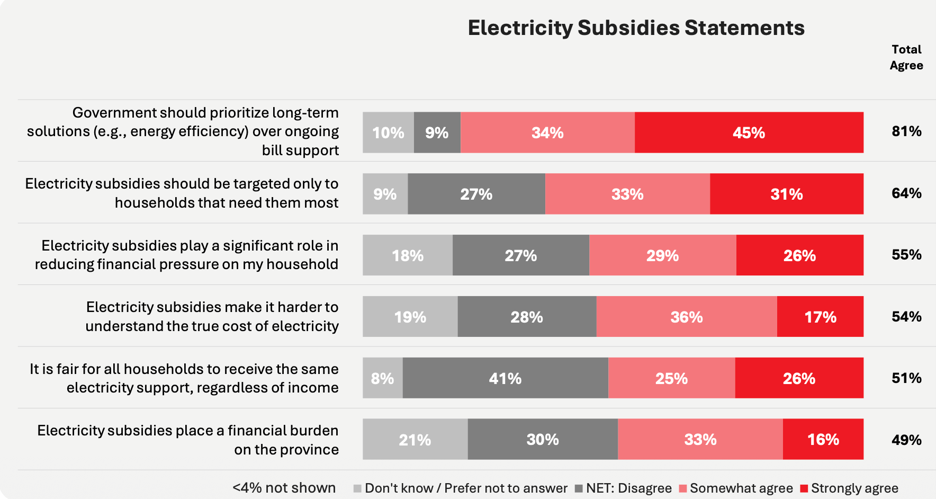
But there was an important limit to this support for reform: Ontarians do not want to eliminate electricity assistance altogether.
People recognize that some households need help keeping their energy bills affordable. The polling suggests that the public is open to changing how support is delivered—but wants assistance to remain available for those who need it, while creating pathways to lower energy costs over the long term.
A better approach to electricity affordability
These findings point to an opportunity for Ontario.
Rather than simply subsidizing electricity use, we can explore ways to make electricity more affordable, efficient and sustainable.
That means considering how electricity subsidies can be better targeted to households facing affordability pressures, while directing more investment toward measures that permanently reduce energy costs. Energy efficiency, electrification and local energy solutions can all play a role.
For Pollution Probe, the goal is straightforward: ensure that every Ontarian can access the energy they need, benefit from electrification and participate in the clean energy transition—without leaving low-income households behind.
Pollution Probe is building on this research to develop practical recommendations for reforming Ontario’s electricity rates and subsidies.
The challenge is significant. But so is the opportunity: a system that protects vulnerable households today while helping all Ontarians achieve lower, more stable energy costs tomorrow.
Stay tuned!