
CALGARY, AB (November 4, 2026) – Electric school buses offer an important opportunity to reduce emissions and improve air quality, but expanding their deployment requires careful planning of the electricity infrastructure that supports them. New Canadian research shows that the biggest grid-planning challenge may not be how much electricity these vehicles need, but where and when they charge.
A new report from Pollution Probe, developed in partnership with Mobility Futures Lab and RFS Energy, with funding support from the Alberta Ecotrust Foundation, examines how electric school bus adoption could affect Calgary’s electricity grid through 2040. Using real-world fleet data, the study models where and when charging demand could emerge across the city, helping identify areas where electricity infrastructure planning may be needed as fleets electrify.
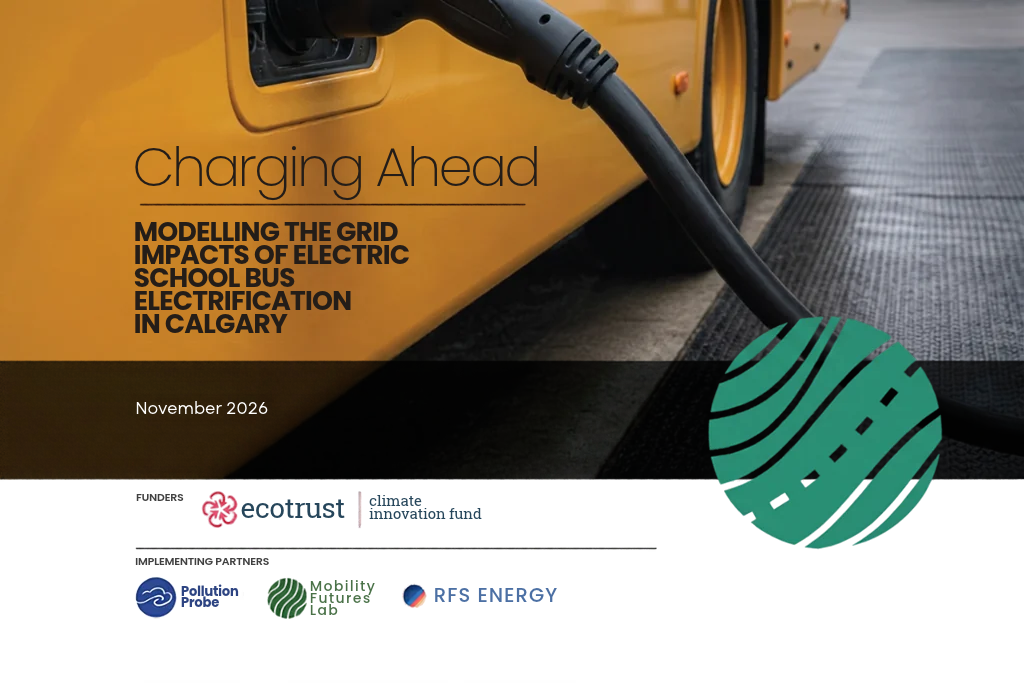
Titled Charging Ahead: Modelling the Grid Impacts of Electric School Bus Electrification in Calgary, the report is among the first Canadian studies to examine the potential electricity grid impacts of school bus electrification at a citywide scale. The study also examines how managed charging and early coordination between fleets and utilities can help reduce potential infrastructure impacts.
Key Findings: What Calgary’s Electric School Bus Future Could Look Like
The report examines different adoption scenarios, charging behaviours and projected infrastructure requirements, identifying several key findings:
- Electric school bus adoption could vary significantly by 2040: Calgary’s electric school bus fleet is projected to reach approximately 170 vehicles under a base adoption scenario and nearly 500 under an aggressive scenario, representing approximately 11% to 33% of the city’s projected school bus fleet.
- Where buses charge matters more than total electricity demand: While electric school buses are expected to add relatively little to Calgary’s overall electricity consumption, charging demand will be concentrated in certain communities and depots. The study identifies areas where this could create pressure on local electricity infrastructure and where early utility planning may be needed.
- Managed charging can reduce peak demand by up to 32%: Staggering charging within available parking windows reduced modelled fleet-level peak demand by approximately 28–32%, helping make better use of existing infrastructure and potentially reducing future upgrade requirements.
“We’ve been looking at the operational and economic challenges of electric school bus deployment for several years, and grid planning is another important part of that work,” said Marc Saleh, Director of Transportation at Pollution Probe. “Utilities need to understand where and when these vehicles will charge so they can plan infrastructure investments ahead of time. While this study focuses on school buses in Calgary, the same modelling approach could help inform planning for other vehicle fleets and communities across Canada.”
The Challenge Isn’t Electricity Supply. It’s Where and When Buses Charge.
One of the report’s most significant findings is that school bus electrification is unlikely to create a major challenge for Calgary’s overall electricity supply. By 2040, annual electricity demand from electric school buses is projected to reach approximately 4.2 gigawatt-hours under the base scenario and 12.3 gigawatt-hours under the aggressive scenario, a relatively modest addition to the city’s total electricity requirements.
The more immediate challenge lies within local distribution networks. School buses typically return to centralized depots after completing their routes, meaning multiple vehicles may begin charging at the same time. This can create concentrated demand in specific neighbourhoods, potentially requiring upgrades to transformers, feeders and other infrastructure.
The research identifies a small number of Calgary substations associated with disproportionately high projected charging demand, highlighting the value of identifying priority areas before electrification accelerates. Managed charging offers a practical solution. By adjusting when buses charge within their available parking windows, fleet operators can reduce peak demand without compromising the energy needed for daily routes.
Pollution Probe welcomes Budget 2026’s proposed investment of $45 million over five years in research and development for EV charging infrastructure. The study highlights the importance of developing charging solutions that lower costs for fleets while making better use of existing electricity infrastructure. Further research should explore how managed charging and electricity rate structures can work together to encourage charging when grid capacity is available, helping reduce costs and support wider electric school bus deployment.
“We didn’t set out to fund four projects. We set out to understand what was holding electric school buses back in Alberta,” said Mike Mellross, Vice-President at Alberta Ecotrust Foundation. “Through our Climate Innovation Fund, each Pollution Probe project answered one question and surfaced the next. Early demonstrations showed electric buses can run reliably through Alberta winters, which raised new questions about how depots should charge a growing fleet and what that charging means for the grid. That’s systems thinking in practice—following the barriers where they lead. This latest study helps operators and utilities plan together, before electrification scales up.”
While the report focuses on Calgary, its findings offer insights for utilities and fleet operators planning electric vehicle charging infrastructure in other Canadian communities. The full report, Charging Ahead: Modelling the Grid Impacts of Electric School Bus Electrification in Calgary, is available at https://www.pollutionprobe.org/charging-ahead-modelling-the-grid-impacts-of-electric-school-bus-electrification-in-calgary/
-30-
About Pollution Probe
Pollution Probe is a national, not-for-profit charitable organization that pursues environmental gains by working productively with governments, industry, and the public. With a steadfast commitment to clean air, clean water, and a healthy planet, Pollution Probe has been at the forefront of environmental issues and action since its inception in 1969. http://www.pollutionprobe.org
About Mobility Futures Lab
Mobility Futures Lab (MFL) is a sustainable mobility consultancy working at the intersection of transportation and energy. MFL operates as an independent research and development platform focused on advancing data-driven approaches to sustainable transportation. Working across the public sector, non-profits, academia, and industry, MFL delivers projects spanning fleet operations, infrastructure planning, transportation policy, and market analysis grounded in an evidence-based approach.
About RFS Energy
RFS Energy is a Canadian energy consulting firm that brings people together to turn energy planning, research and climate policy into practical solutions. With more than 50 years of combined experience working with utilities, governments and organizations across Canada, RFS Energy helps advance innovative approaches to energy challenges through collaboration, strategic planning and real-world implementation. Learn more at www.rfs.energy.
About Alberta Ecotrust Foundation
Alberta Ecotrust Foundation is a non-profit organization advancing environmental and climate solutions across Alberta. The foundation collaborates with diverse partners from government, industry, non-profits, and Indigenous communities to create a future where both people and nature thrive. Since 1991, Alberta Ecotrust has mobilized resources, delivered innovative programs, and supported impactful projects that protect and restore natural ecosystems, reduce greenhouse gas emissions, and build community resilience. Alberta Ecotrust is a founding member of the Low Carbon Cities Canada network, a national initiative accelerating equitable climate solutions in cities. Learn more at www.albertaecotrust.com.
For more information, please contact:
Erin McKay, Media Partner
Bubblegum Canada
(416) 455-9960